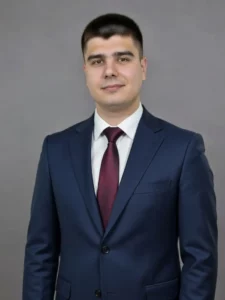
Igor Odynets is a political analyst and international lawyer with more than a decade of cross-sector experience at the intersection of law, public policy, and strategic analysis. He built his early career across leading Ukrainian and international law firms and advisory practices before transitioning into public policy roles that combine legal acumen with geopolitical and institutional analysis.
Since 2019, Igor has served as an external advisor to the Ministry of Finance of Ukraine through the Ukraine Reforms Architecture (URA), a comprehensive technical assistance program deployed by the European Bank for Reconstruction and Development (EBRD) in partnership with the European Union. Following Russia’s full-scale invasion in 2022, Igor turned his focus to security policy and defense innovation. He co-founded the Heroes and Allies Foundation, a wartime nonprofit channeling private and institutional resources toward Ukraine’s defense capabilities and critical infrastructure reconstruction. This engagement positioned him within Ukraine’s emerging defense-tech ecosystem, fostering operational knowledge and direct collaboration with engineers, manufacturers, volunteers, and frontline units.
Igor holds an M.A. in Politics with distinction from Central European University (2025) and an LL.M. with Merit from Queen Mary University of London (2022), where he studied as a Chevening Scholar. He is also engaged in supervised research with the CEU Democracy Institute and the EU Enlargement Hub, focusing on defense tech research. He maintains an extensive international network among policymakers, diplomats, think tank experts, and media across both Ukraine and the Euro-Atlantic space. His work is regularly sought after by Western and Ukrainian partners for its analytical depth, institutional insight, and policy relevance.
His research and strategic analysis focus on:
• The systemic contest between democracies and authoritarian regimes, particularly the institutional dimensions of U.S.–China rivalry.
• Governance of dual-use and defense technologies in democratic systems responding to acute security threats.
• Institutional resilience and the adaptation of EU governance frameworks in the face of coercion and geopolitical confrontation.
• Capability-building instruments within EU and NATO architectures
• The integration of Ukrainian military tech and dual-use startups into European value chains and regulatory ecosystems.